
Índice de contenidos
When people talk about types of dental implants, it is easy to come across terms like titanium implants, zirconia, short, narrow, immediate-load or implants for a full denture. Not all of them, however, describe the same thing.
Some refer to the material of the implant; others to its size or position; and others to the prosthesis fitted on top or to when it is loaded. That is why there is no single “best dental implant” for everyone.
At Clínica Dental Hernández & Espuelas we carry out a personalised study to assess the bone, the gums, the bite and the type of restoration you need. That way we can choose the option that restores function, appearance and hygiene safely and stably.
What do we mean by types of dental implants?
A dental implant is the artificial root placed inside the bone. A crown, a bridge or a full prosthesis is connected on top of it, depending on how many teeth are missing.
Before comparing options, it is worth distinguishing between the implant itself, the surgical technique and the final prosthesis. They are related, but they are not the same thing.
The implant is not the crown or the prosthesis
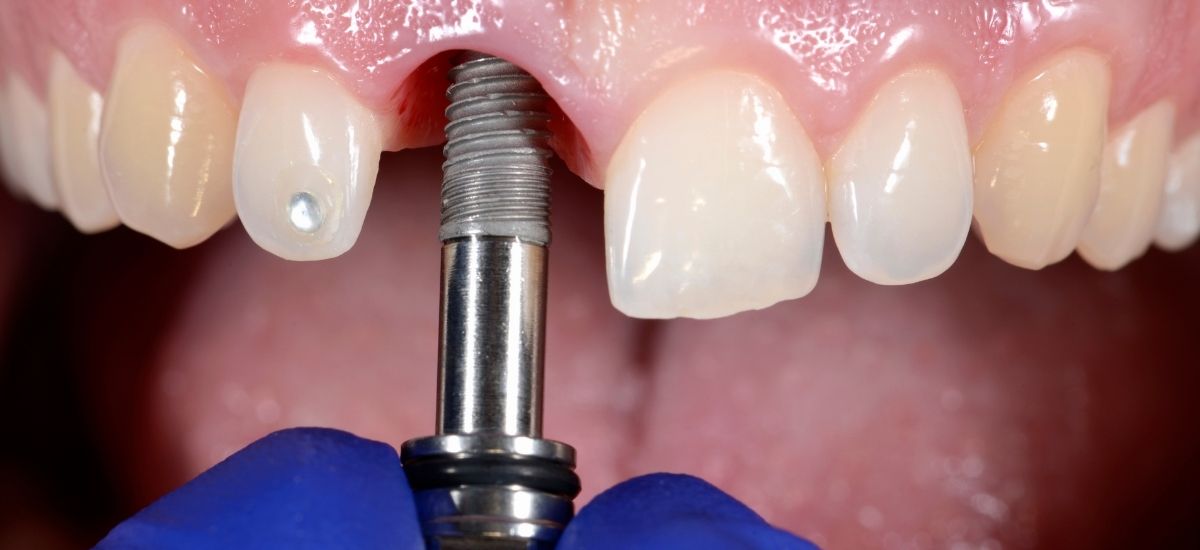
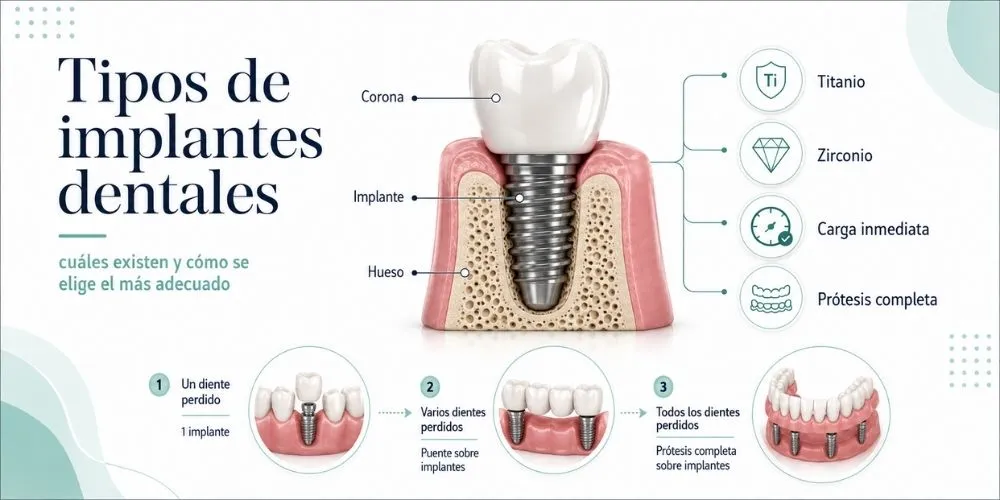
The implant is the part placed inside the bone, acting as an artificial root. The crown or prosthesis is the visible part of the treatment, the one that restores appearance and function when chewing.
So when someone talks about “having an implant”, the treatment may involve several components: the implant, the abutment that connects the prosthesis and the crown or final restoration. If you want to understand better what dental implants are and how they work, you can read more in our dedicated guide.
Type of implant, type of prosthesis and loading technique
The phrase “types of implants” is often used for very different things. For example, immediate loading is not a type of implant but a technique that allows a fixed temporary prosthesis to be fitted on the same day as surgery or shortly afterwards, when the case allows it.
In the same way, an implant-supported bridge or a full-arch restoration does not describe the type of screw placed in the bone, but the prosthetic solution used to replace several teeth. To choose properly, we have to weigh all these elements together.
Implants by their position in the bone
This classification describes where the implant rests or is placed. Although there are different options, they are not all used equally often in current practice, nor are they indicated for the same cases.
The choice will depend mainly on the quantity and quality of bone available, the area to be restored and the prosthesis to be fitted.
Endosseous implants: the most widely used
Endosseous implants are the most common. They are placed directly inside the upper or lower jawbone and are usually shaped like a small screw.
A single crown, a bridge or a full prosthesis can be fitted on them, depending on how many teeth need replacing. Their design, length and diameter are chosen individually according to the space available and the characteristics of the bone.
Subperiosteal implants: an uncommon option
Subperiosteal implants sit under the gum and on top of the bone, rather than inside it. They are reserved for very specific situations and are not the usual alternative in implant dentistry today.
Where there is little bone, before opting for this kind of solution it is necessary to study what other alternatives could offer a restoration that is more predictable and easier to maintain long term.
Advanced techniques when bone is missing
Having little bone does not automatically mean implants are impossible, nor that there is a single “special implant” that solves it. Depending on the case, techniques such as bone regeneration, a sinus lift or other procedures suited to the area may need to be considered.
In severe atrophy of the upper jaw, when there is no longer enough bone even to graft, there is also a surgical alternative: zygomatic implants, which instead of anchoring in the jaw are fixed into the cheekbone. It is a technique reserved for very specific cases and requires a dedicated surgical assessment, so it is only considered when the CT study rules out the options above.
The decision will depend on the volume of bone, the quality of the gum, where the missing tooth is and the type of prosthesis planned. The aim is not to use a particular technique, but to achieve a sound foundation for a restoration that is functional, attractive and stable.
Implants by their material
The material of the implant matters, but it should not be the only criterion for choosing a treatment. The stability of the bone, the condition of the gums, the position of the implant and the design of the final prosthesis count as much or more than the material used.
The choice should therefore always be made after a personalised study, and not simply because one material is better known or better looking.
Titanium implants
Titanium implants are the most widely used in implant dentistry and have a long clinical track record. Titanium is chosen for its good biocompatibility and its ability to integrate with bone through osseointegration.
There are also different titanium designs and surfaces, which allow the treatment to be adapted to the amount of bone available, the area to be restored and the type of prosthesis required.
Zirconia implants
Zirconia implants are a ceramic alternative that can be considered in selected cases. Their white colour can be useful in certain aesthetic situations, particularly when the gum is very thin or there is a risk of the implant colour showing through.
They should not, however, automatically be considered better than titanium implants. The choice will depend on the planning, the characteristics of the case and the availability of systems suitable for carrying out the restoration safely.
Titanium or zirconia: which is better?
There is no single answer. Titanium remains the benchmark material because of how widely it is used and the long-term clinical evidence available.
Zirconia can be an alternative in specific situations, but the decision has to be made case by case. What matters most is that the implant, the position it is placed in and the final prosthesis are all properly planned.
Implants by their size and design
Not all implants have the same diameter, length or shape. These characteristics are chosen according to the space available, the quantity and quality of bone and the tooth or prosthesis being replaced.
There is no standard size that works for every patient. The right size is the one that achieves stability and allows a prosthesis that is functional, attractive and easy to clean.
Conventional implants
Conventional implants are used when there is enough bone volume and space to place them. Their length and diameter are chosen after studying the area with imaging and planning the position of the future crown or prosthesis.
The aim is not to place the largest possible implant, but to select the design that best suits the anatomy and the forces it will have to withstand.
Short or narrow implants
Short or narrow implants can be considered when bone height, ridge width or the space between teeth is limited. They can be an alternative in certain cases, but they are not automatically the best solution for everyone with little bone.
In some situations it is better to carry out bone regeneration, change the prosthetic plan or choose another technique. The decision will always depend on the study of the bone, the gums and the bite.
Can mini-implants replace any tooth?
Mini-implants have specific indications and do not always take the place of conventional implants. In implant dentistry they can be used in some cases to add stability to removable prostheses, particularly where there is little space or the aim is to improve the retention of a denture.
It is also important not to confuse them with mini-screws used in orthodontics, which are placed temporarily as anchorage to move teeth and cannot replace missing ones. The choice between a conventional, short, narrow or mini-implant must always rest on the individual treatment plan.
Types of treatment by how many teeth are missing
When people look up types of implants, the real question is often not which screw will be placed, but which solution will replace the missing teeth.
Not every case needs the same number of implants or the same type of prosthesis. The choice will depend on the area, the bone available, the bite, hygiene and each patient’s needs.
Implant with a crown to replace a single tooth
When a single tooth is missing, an implant with a single crown can be considered. This replaces the missing tooth without having to grind down the neighbouring ones, provided the bone and gum conditions are suitable.
The crown is designed to blend in with the rest of the smile and keep chewing working properly. Planning matters especially in the front teeth, where we also have to look after the appearance of the gum.
Implant-supported bridge for several teeth
When several adjacent teeth are missing, it is not always necessary to place one implant per missing tooth. In many cases a bridge supported by a set number of implants can be designed.
The distribution will depend on the area to be restored, the amount of bone available and the chewing forces the prosthesis will have to withstand. The goal is a solution that is stable, functional and easy to clean.
Full implant-supported prosthesis
When all the teeth in an arch are missing, implants can be used to support a full prosthesis. This may be fixed or removable, depending on the number of implants, the anatomy, the bone available and each person’s needs.
A fixed implant-supported prosthesis can feel closer to natural teeth. Removable implant-supported prostheses, for their part, can substantially improve stability compared with a conventional denture. The best alternative is always decided after a personalised study.
Implants to stabilise a removable denture
If a removable denture moves when you speak or eat, implants can help improve its retention. The prosthesis then sits more securely and can bring greater confidence and comfort day to day.
The number of implants needed and the anchorage system will depend on the arch, the bone and the type of prosthesis. Not every patient needs a fixed prosthesis to gain a significant improvement in stability.
Immediate-load implants: what they are and when they can be done
Immediate loading is not a type of implant but a technique that allows a fixed temporary prosthesis to be fitted on the day of surgery or shortly afterwards. It can be a very appealing option for some patients, but it is not indicated in every case.
Having a temporary prosthesis from the start does not mean the treatment is over. The implant needs a healing period and the final prosthesis is fitted once the tissues are ready.
When it can be an option
To consider immediate loading, the implant has to achieve adequate primary stability. We also have to study the quantity and quality of bone, the condition of the gums, the bite and how chewing forces are distributed.
When conditions are favourable, it can let the patient leave the clinic with a fixed temporary prosthesis while osseointegration completes.
When waiting may be better
In some cases it is safer to wait before fitting a fixed temporary prosthesis. For instance, if the necessary stability is not achieved, if substantial bone regeneration is needed or if gum conditions are unfavourable.
The presence of infection, the quality of the bone and the prosthetic plan also have to be assessed individually. Waiting for healing is not a setback but a clinical decision aimed at protecting the long-term result.
How is the most suitable type of implant chosen?
The choice should not rest on price, advertising or the name of a technique. A well-indicated implant starts from a complete diagnosis that reveals the characteristics of the mouth and allows the final prosthesis to be planned before surgery.
The aim is to choose a solution that is safe, functional, attractive and easy to maintain over time.
Studying the bone with a dental CT scan
The dental CT scan lets us analyse the height, width and quality of the bone available. It also helps locate important anatomical structures, such as the maxillary sinus above or certain nerves in the lower jaw.
With that information we can decide whether there is enough bone, what size and position the implant can have, or whether an additional technique needs considering before placement.
The condition of the gums and general health
Before placing an implant, the patient’s gums and general health also have to be checked. Active periodontitis , insufficient hygiene, smoking or certain uncontrolled illnesses can change the treatment plan.
Treating gum problems beforehand and controlling risk factors helps create better conditions for healing and for maintaining the implant.
The final prosthesis guides the planning
Before placing an implant we need to know what crown or prosthesis we want on top, where it has to sit and how it will fit in with the rest of the teeth and the bite.
This planning allows the implant to be placed in a position that makes appearance, function and hygiene easier. It is not just about putting an implant in the bone, but about designing the tooth we want to restore from the outset.
The best type of implant is the one that fits your case
There is no implant that is best for every patient. The choice depends on the bone, the gums, the bite, how many teeth are missing and the type of prosthesis you need.
At our clinic we carry out a personalised study to assess which dental implants in Ibi option best suits each case.
At Clínica Dental Hernández & Espuelas in Ibi we carry out a personalised diagnosis to choose an implant solution that is safe, attractive and easy to maintain. Book your appointment through our website and we will look at which type of implant can help you get your smile back.
Frequently asked questions about types of dental implants

Fernando Hernández
I hold a bachelor’s degree in dentistry from CEU Cardenal Herrera University and a master’s degree in surgery and implantology from the University of Murcia, where I have also been an adjunct professor for the master’s program since 2016. I have been practicing oral surgery and implantology for more than a decade.
I work with computer-guided surgery, dental CT scans, and intraoral scanners, which allow me to plan each implant before entering the operating room and offer immediate loading when the case allows it. I use Nobel Biocare and Straumann implant systems.
At Hernández & Espuelas (Ibi), I handle the surgical side of things: implants, bone regeneration, complex extractions, and surgical periodontics. I’m writing this to address the most common questions: whether you’re a candidate for implants, how long they last, and what to expect during recovery.

