
Índice de contenidos
There are several different ways to align teeth and correct the bite today. Metal braces are still a very effective option, but we also have ceramic braces, lingual orthodontics and clear aligners such as Invisalign or Spark.
With so many alternatives, it is only natural to wonder which is best.
The answer is that there is no single type of orthodontics that suits everyone. The choice depends on the problem to be corrected, the tooth movements required, age, hygiene, aesthetic preferences and the patient’s ability to follow instructions.
There is something else worth bearing in mind: the result does not depend on the appliance alone. The diagnosis, the orthodontist’s planning and the follow-up during treatment carry decisive weight.
In this article we explain what types of orthodontics exist, what their advantages and limitations are, and how to work out which system might suit your case best.
Which type of orthodontics is best?
Clear aligners tend to be very comfortable, discreet and easy to keep clean, but they demand real consistency. Metal braces are hard-wearing and stay active all day long.
Ceramic braces work in a similar way, though they blend in better. Lingual orthodontics, meanwhile, is completely hidden from the outside, but getting used to it can be more demanding.
| Type of orthodontics | Main advantage | Main limitation | May suit you better if… |
|---|---|---|---|
| Clear aligners | Comfort, discretion and hygiene | They require consistency | You can wear them for the hours indicated |
| Metal braces | Strength and continuous control | They are visible | You prefer a fixed system |
| Ceramic braces | Less visual impact | More demanding hygiene | You want more discreet braces |
| Lingual orthodontics | Not visible from the outside | More complex to get used to | Invisibility is the priority |
| Children’s appliances | They act during growth | They depend on the stage of development | The bite needs correcting early |
The best option will be the one that allows the necessary movements to be carried out properly and that you can use consistently throughout the treatment.
What is orthodontics and what problems can it correct?
Orthodontics is the dental speciality that studies and corrects the position of the teeth and the way they meet when biting.
Its aim is not only a more aligned smile. It also seeks to improve the way the teeth fit together, make hygiene easier and distribute chewing forces properly.
It can be used to treat problems such as dental crowding, gaps between teeth, crossbite, open bite, deep bite or an excessive overjet of the upper teeth.
It can also correct midline deviations and certain problems related to the growth of the jaws.
Two people who appear to have crooked teeth may need very different treatments. That is why, before choosing the appliance, the origin of the problem and the relationship between the two arches have to be studied.
How types of orthodontics are classified
Treatments can be classified in different ways. By type of appliance, we mainly talk about fixed and removable orthodontics.
Fixed orthodontics uses elements that stay bonded to the teeth throughout the treatment. This group includes metal, ceramic and lingual braces.
Removable orthodontics uses appliances the patient can take out. Clear aligners are the most common example in teenagers and adults, although there are also removable appliances used during childhood.
Another classification distinguishes between interceptive and corrective orthodontics. Interceptive orthodontics is carried out during growth to act on certain problems before they become established. Corrective orthodontics is used when the malocclusion is already set and the teeth have to be moved or their relationship changed.
These classifications are not mutually exclusive. A child may wear a fixed or removable appliance within an interceptive treatment, while an adult may have corrective orthodontics with braces or aligners.
Invisible orthodontics with clear aligners
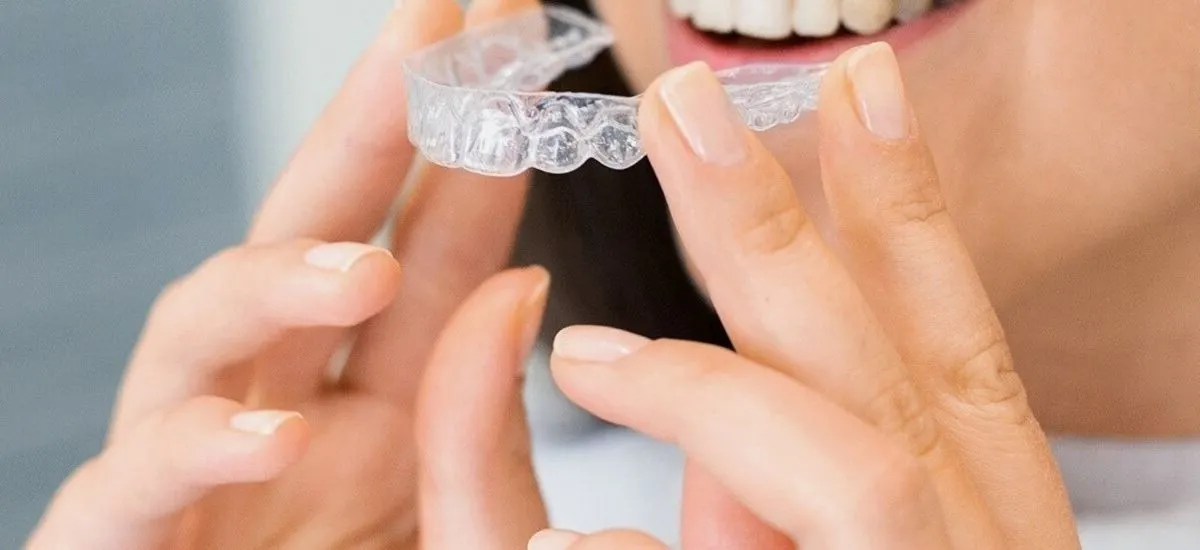
Invisible orthodontics uses custom-made clear trays that move the teeth gradually. Each aligner is designed to carry out part of the planned movements. As treatment progresses, the patient changes the trays following the orthodontist’s instructions.
At Hernández & Espuelas we work with systems such as Invisalign and Spark, which allow the treatment to be planned digitally from an intraoral scan.
Before starting we can study the initial position of the teeth, design the movements and view an approximation of the expected result.
The advantages of clear aligners
One of their main advantages is discretion. Aligners are practically transparent and usually go unnoticed in social and professional life. Although they may need small tooth-coloured attachments, their visual impact is limited.
They can also be taken out to eat and brush your teeth, which makes hygiene easier and avoids the dietary restrictions that usually come with fixed orthodontics. As they use no brackets or wires, they tend to rub less against the lips and cheeks.
Another advantage is that the treatment is planned digitally, which allows detailed control over the order and direction of the movements.
The limitations of aligners
Their main limitation is that they depend on the patient’s cooperation. To work properly they have to be worn for roughly 20 to 22 hours a day. If they are worn less, the teeth may stop following the plan and the trays may start to fit poorly.
They also have to be taken out to eat, cleaned and put back in. For some people this routine is straightforward, while others find it hard to keep up for months.
Aligners do not always work on their own. Depending on the case they may need attachments, elastics, interproximal reduction or additional refinements.
They should not, therefore, be seen as a set of standard trays, but as one tool within a complete orthodontic plan.
What problems can they correct?
Aligners can now be used in many cases of crowding, diastemas, deep bite, open bite or crossbite. They can also treat more complex situations when combined with auxiliary elements and backed by proper planning.
Not all movements are equally difficult, however. The orthodontist has to judge whether the system offers enough control and whether the patient will manage the required wear time.
Invisalign or Spark: what are the differences?
Invisalign and Spark are two professional clear aligner systems.
Both allow custom trays to be designed, movements to be planned digitally and attachments, elastics and refinements to be added when needed. There may be differences in the material, the transparency, the fit and the digital tools each system uses.
There is no brand that is universally better for every patient, though. The result depends as much on the diagnosis, the design of the movements and the experience of the professional leading the treatment as on the system itself.
At Hernández & Espuelas we work with both Invisalign and Spark, which lets us judge which option best fits each patient’s bite, needs and daily routine.
Metal braces
Metal braces are a fixed orthodontic system that uses small brackets bonded to the teeth and joined by an archwire. The wire transmits controlled forces that move the teeth towards the planned position.
Although they are usually seen as the most traditional option, that does not make them outdated. Materials, archwires and planning techniques have advanced considerably.
The advantages of metal braces
They are hard-wearing and can treat a wide range of malocclusions. Because they stay bonded to the teeth, they do not depend on the patient remembering to put the appliance in each day.
That can be an advantage for people who know they would struggle with the aligner routine. They also tend to be a more affordable option.
Limitations
Their main drawback is that they are visible. Hygiene also needs more care, because plaque and food debris can build up around the brackets and wires.
During treatment it is also best to avoid very hard or sticky foods that could debond a component. At first they may rub against the lips and cheeks, although most patients gradually get used to them.
Ceramic and sapphire braces
Ceramic braces work in a similar way to metal ones, but they are made from materials designed to blend in against the tooth. Ceramic brackets usually have a shade close to enamel, while sapphire ones are more transparent.
They are an alternative for those who prefer a fixed system but want to reduce how much it shows.
They should not, however, be confused with completely invisible orthodontics. The wire and other components can still be seen close up. Hygiene and dietary precautions are similar to those for metal braces. There may also be differences in strength, friction or fracture risk depending on the material used.
Self-ligating braces: are they really faster?
Self-ligating brackets have a small mechanism that holds the archwire in place without the conventional elastic ligatures.
This system can make certain adjustments and phases of treatment easier. It cannot be claimed, however, that it always shortens the overall duration.
The time depends mainly on the complexity of the malocclusion, the biological response, the movements required and the patient’s cooperation.
The choice between conventional and self-ligating braces should be based on what the treatment needs, not simply on the promise of finishing sooner.
Lingual orthodontics
Lingual orthodontics uses brackets placed on the inner surface of the teeth. They cannot be seen from the outside, which makes it the most discreet fixed system.
The advantages of lingual orthodontics
Its main advantage is aesthetic. The appliance stays hidden even when you smile or speak. And because it is fixed, it works all day and does not depend on the patient remembering to put it in.
It can be an alternative for people who want orthodontics that is completely invisible from the outside and who prefer a fixed system.
Limitations
The tongue is in direct contact with the brackets, so getting used to them can be more demanding.
During the first few weeks there may be rubbing and temporary changes in pronunciation. Hygiene also needs particular attention and appointments tend to be technically more complex.
The cost is usually higher too, because of how customised the system is and how demanding the procedure is. Lingual orthodontics may be the least visible option, but not necessarily the most comfortable one.
Children’s and interceptive orthodontics
Children’s orthodontics is not just about fitting braces once all the permanent teeth have come through. During growth it may be necessary to act on the development of the jaws, on how the teeth erupt or on certain habits.
Interceptive orthodontics can be used where there is a narrow palate, a crossbite, a lack of space or a mismatch between the upper and lower jaw.
It can also be important to keep an eye on habits such as thumb sucking, prolonged dummy use or certain breathing and swallowing patterns. Not every child needs to start treatment early.
In some cases check-ups to monitor how things develop are enough. In others, stepping in at the right moment can simplify later treatment or stop the problem getting worse.
The choice of appliance will depend on the type of problem, the age, the growth and the child’s ability to cooperate.
Can every system carry out the same movements?
Teeth do not simply shift from side to side.
During treatment it may be necessary to rotate them, tip them, move their roots, push them slightly into the bone or bring them down. Gaps may also need closing, space creating, the arch expanding or the upper and lower bite coordinating.
Aligners can perform many of these movements, but in certain cases they need attachments, elastics or other auxiliary elements to improve control.
Braces apply forces continuously, although they too may require elastics, mini-screws or other resources.
This does not mean one system is always better than the other. It means the biomechanics change and the orthodontist has to know how to achieve the intended movement with each technique. The choice should not rest solely on which appliance shows least.
Comparing the main types of orthodontics
| Feature | Aligners | Metal braces | Ceramic braces | Lingual orthodontics |
|---|---|---|---|---|
| Visibility | Very low | High | Intermediate | None from the outside |
| System | Removable | Fixed | Fixed | Fixed |
| Hygiene | Simpler | More demanding | More demanding | More complex |
| Diet | No restrictions once removed | Requires precautions | Requires precautions | Requires precautions |
| Reliance on the patient | High | Lower | Lower | Lower |
| Getting used to it | Generally quick | Possible rubbing | Possible rubbing | Tongue and speech |
| Digital planning | Standard | Can be added | Can be added | Depends on the system |
Price should not be the only basis for comparison, since it can vary with the complexity, the duration and the goals of the treatment.
Which type of orthodontics is fastest?
There is no type of orthodontics that is always the fastest.
Aligners can be very efficient in some mild or moderate treatments, particularly when specific movements are needed and the patient follows the instructions properly. In other cases, however, a fixed system can offer more predictable control.
The duration depends on the initial complexity, the number of movements, the biological response and the patient’s compliance. The use of elastics, attendance at appointments and the need for refinements or adjustments also play a part. Promising that one appliance will always finish sooner than another creates unrealistic expectations.
Which type of orthodontics is most comfortable?
Aligners tend to rub less and let you eat and brush your teeth normally. For many people that makes them the most comfortable option. They do, however, have to be removed, cleaned and put back after every meal. They also demand real consistency.
Braces stay active all day and do not depend on that routine. In exchange, they can irritate the soft tissues and call for more care with diet and hygiene. Comfort is not only about physical sensation, but also about the kind of routine each patient can keep up.
Which type of orthodontics looks best?
Lingual orthodontics is the least visible system because it is placed on the inner surface of the teeth. Clear aligners are also very discreet, although they may include attachments that can be seen close up.
Ceramic braces show less than metal ones, but they are still visible. Metal braces are the most obvious of all. The best-looking option is not necessarily the most comfortable one, nor the most suitable for every case.
Which type of orthodontics to choose for your situation
If you are after discretion and easy hygiene, clear aligners are usually one of the most complete options. If you know you would struggle to wear a removable appliance for the hours required, a fixed system can offer greater predictability.
Metal braces can be a good fit when strength and function are the priority. Ceramic braces keep the benefits of a fixed system while showing less.
Lingual orthodontics is worth considering when being invisible from the outside is the main priority and the patient accepts a more demanding adaptation. In children, the decision depends above all on growth and on when the problem appears.
How we choose the type of orthodontics
Before recommending a system we carry out a complete study. We do not simply look at whether the teeth are crooked. We also analyse the bite, the position of the roots, the condition of the gums and the bone.
In children we also assess growth and how the teeth are erupting. We take hygiene, aesthetic expectations and the ability to use a removable appliance properly into account as well.
The presence of implants, crowns, veneers or missing teeth can change the planning. At Hernández & Espuelas we use an intraoral scanner and digital planning to record the mouth and design the movements before starting treatment.
This technology allows the case to be studied precisely, but it does not replace diagnosis or clinical judgement.
What happens before treatment starts
Before fitting braces or handing over the first aligners, the mouth has to be in good condition. If there are cavities, gingivitis or periodontitis, these have to be treated first.
We also have to check hygiene, the state of any restorations and whether there are impacted teeth or other problems that could interfere. In some patients it is advisable to have first a dental cleaning, treatment for cavities, periodontal treatment or oral surgery.
Starting orthodontics in a mouth with inflammation or infection increases the risks and makes treatment harder.
Conclusion: which type of orthodontics should you choose?
The best type of orthodontics is not necessarily the newest, the most expensive or the least visible. It is the system that corrects your bite properly and that you can use consistently throughout the treatment.
Clear aligners offer great comfort and discretion, but they need cooperation. Braces are hard-wearing and act continuously. Lingual orthodontics stays hidden from the outside, although getting used to it is more demanding.
At Hernández & Espuelas we study every case with a clinical examination, an intraoral scan and digital planning. If you are thinking about starting orthodontic treatment, you can request a free first visit at our dental clinic in Ibi.
We will analyse your case and explain clearly which systems are suitable, how long treatment might take and what it would cost.
Frequently asked questions about types of orthodontics

Santiago Espuelas
I am an orthodontist and have been practicing exclusively in orthodontics since 2005. I hold a Master’s degree in Orthodontics and Dentofacial Orthopedics from Rey Juan Carlos University in Madrid and an Expert Master’s degree in Invisible Orthodontics (2024).
I work every day with Invisalign (Platinum Elite certification), Spark (Sapphire Plus), 3M Incognito lingual braces, and conventional braces. I plan all cases using a 3Shape intraoral scanner and 3D software, so you can see what your smile will look like before we begin.
At Hernández & Espuelas (Ibi), I handle all aspects of orthodontics for children, teenagers, and adults. In this blog, I write about the questions you ask me most often during your appointments: what type of orthodontic treatment is right for you, how long treatment takes, and how to maintain the results.

