
Índice de contenidos
Losing a tooth does not only affect the appearance of your smile. It can also make chewing harder, shift the position of the neighbouring teeth and cause progressive changes in the bone and the gum.
Dental implants make it possible to replace one or several teeth with an artificial root placed in the bone. A crown, a bridge or a full denture is then connected to it, depending on each patient’s needs.
One thing is worth making clear from the outset: the implant is not the visible tooth. The implant is the part that stays inside the bone, while the crown or prosthesis is the structure we see and use to chew.
Nor do all treatments follow the same process. Some patients can receive a fixed temporary prosthesis on the same day as surgery, while others need to wait for the implant to heal, or to have gum treatment or bone regeneration first.
In this article we explain what dental implants are, how they work, when they are recommended and which factors influence the success of the treatment.
What is a dental implant and when is it recommended?
A dental implant is an artificial root, usually made of titanium, placed in the upper or lower jawbone to replace the root of a lost tooth.
On top of that implant we can place a single crown, a bridge to replace several teeth, or a full prosthesis when every tooth in an arch is missing.
Implants are usually recommended when one or several teeth are missing and the bone, the gum and general health are in suitable condition for the treatment.
If there is little bone, active periodontal disease or any medical circumstance that could affect healing, preliminary treatment may be needed or the procedure may have to be adapted.
| Situation | Solution that may be considered |
|---|---|
| A single tooth is missing | Implant with a single crown |
| Several adjacent teeth are missing | Implant-supported bridge |
| All the teeth are missing | Full implant-supported prosthesis |
| There is little bone | Bone regeneration or specific techniques |
| There is active periodontitis | Periodontal treatment first |
| A quick temporary prosthesis is wanted | Immediate loading, if the case allows it |
What exactly is a dental implant?
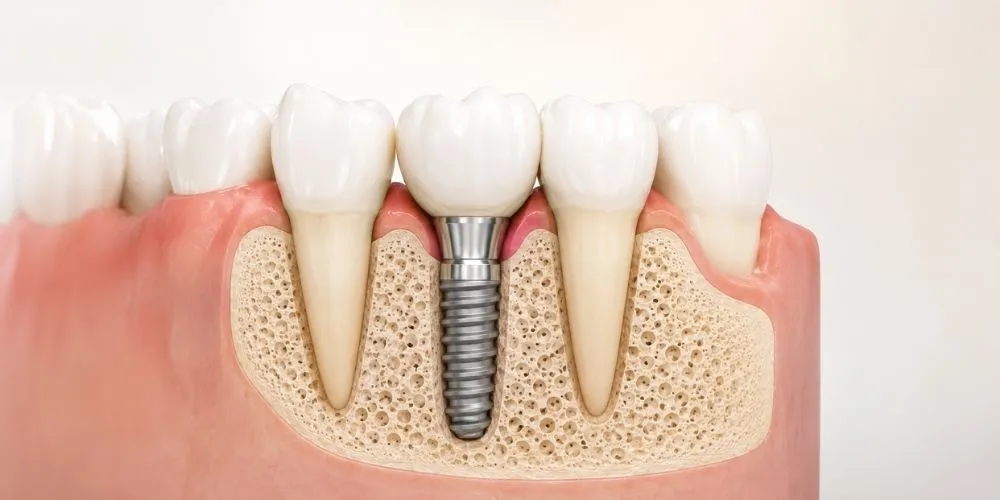
A natural tooth consists of a visible crown and a root that stays inside the bone.
When the tooth is lost, both parts disappear. The implant replaces only the root. A prosthesis replacing the visible part is then placed on top of it.
For that reason, when we talk about a “tooth on an implant” we are really referring to an assembly made up of several parts.
The implant is usually screw-shaped and designed to integrate into the bone. Titanium is one of the most widely used materials because it has good biocompatibility and allows bone tissue to heal around its surface.
The aim is not simply to fill a gap. Implant treatment has to restore chewing function, allow proper hygiene and achieve an appearance that fits in with the rest of the smile.
The parts of a dental implant
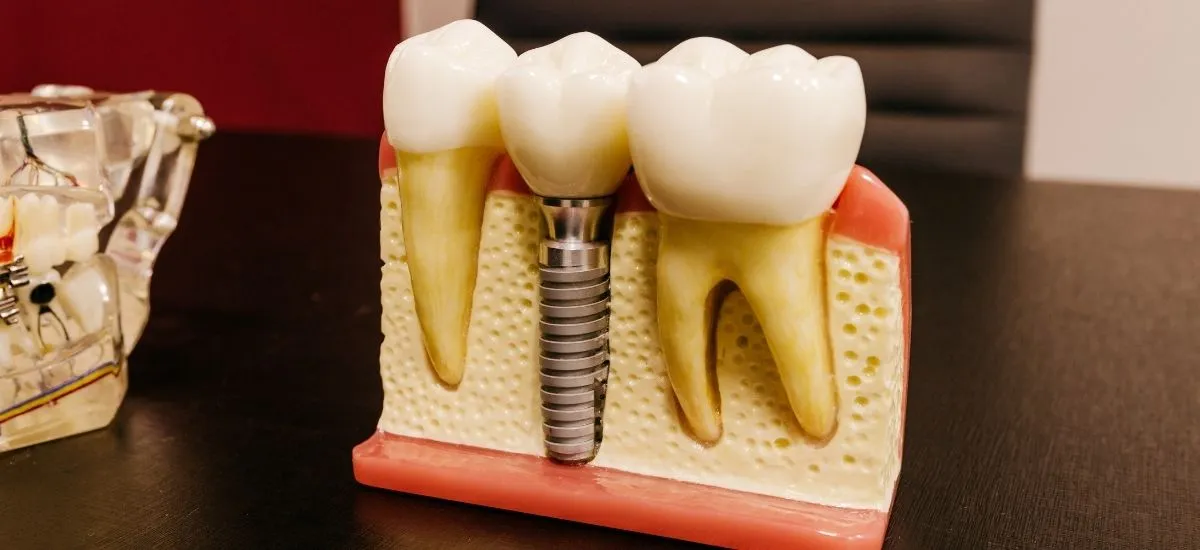
A tooth restored with an implant is usually made up of three main components.
The implant
This is the part placed inside the bone, acting as an artificial root. Its shape, length and diameter are chosen according to the space available, the amount of bone and the area being treated.
The abutment
The abutment is the connection between the implant and the crown or prosthesis. It can have different designs depending on the type of restoration, the position of the implant and the aesthetic requirements.
The crown or prosthesis
This is the visible part of the treatment and the one that restores chewing. It may be a single crown, a bridge or a full prosthesis supported by several implants.
The crown is subject to the wear that comes with use. It may therefore need repair or replacement over time without the implant inside the bone having failed at all.
How does a dental implant work?
How an implant works rests on two different phases: primary stability and osseointegration.
Primary stability
At the time of surgery, the implant has to be sufficiently stable inside the bone.
That stability depends on the quality and quantity of bone, the design of the implant and the surgical technique.
It matters especially when an immediate temporary prosthesis is being considered, because the implant has to withstand forces in a controlled way while it heals.
Osseointegration
After placement, a biological process begins called osseointegration.
During this period, the bone heals around the surface of the implant and creates a stable bond.
The implant does not stick to the bone straight away. At first it is held by its mechanical stability and, gradually, the body creates the biological bond that will allow it to support the prosthesis.
How long this process takes varies with the area treated, the condition of the bone, the primary stability and the patient’s capacity to heal.
Fitting the prosthesis
When the implant is ready to be loaded, the records needed to design the crown or prosthesis are taken.
The restoration has to fit correctly to the implant, the gum, the neighbouring teeth and the bite.
A poorly designed prosthesis can be hard to clean or generate unsuitable forces, even when the implant is correctly placed.
Why don’t all implants follow the same process?
No two implant treatments are exactly alike. The procedure can vary depending on the number of teeth lost, the area to be restored, the bone available and the condition of the gum.
The bite, aesthetics, smoking, general illnesses, medication and the patient’s ability to maintain proper hygiene all play a part too.
An implant to replace an upper incisor, for instance, calls for very precise aesthetic planning. It is not enough for the implant to integrate: a natural-looking gum and a crown that harmonises with the neighbouring teeth are needed too.
In a posterior area, by contrast, the capacity to withstand chewing forces carries particular weight.
That is why treatment must be designed from a complete diagnosis, not from a standard solution applied to every patient.
When is placing an implant recommended?
An implant is not the only option, but there are specific situations where it tends to be the most predictable one. These are the five most common, so you can identify which one resembles your case.
When a single tooth is missing
An implant with a crown replaces a lost tooth without having to rest the restoration on the neighbouring teeth.
That is an important difference compared with some conventional dental bridges, which may require preparing the teeth on either side of the gap.
When several teeth are missing
When several adjacent teeth are missing, it is not always necessary to place one implant per tooth.
In many cases a bridge supported by fewer implants can be designed, provided the loads are distributed appropriately.
When all the teeth are missing
Implants can also support full dentures.
These prostheses may be fixed or removable, depending on the number of implants, the bone, the anatomy, hygiene and the patient’s needs.
A removable implant-supported denture can offer far more stability than a conventional one. A fixed prosthesis feels closer to having your own teeth, although it calls for specific hygiene and more complex planning.
When a removable denture moves
A full denture that is not stable can make eating or speaking with confidence difficult.
Implants can be used to improve its retention, reduce movement and increase comfort.
After an extraction
In some cases the implant can be placed immediately after the tooth is removed.
In others it is better to wait for the area to heal.
The decision depends on whether there is infection, the condition of the bone and the gum, and the stability that can be achieved.
Placing the implant on the same day does not necessarily mean finishing the whole treatment. It may be necessary to wait before fitting the final crown.
Is saving the natural tooth always better?
Whenever it is possible and the prognosis is good, keeping the natural tooth is usually the first choice.
Implants are an excellent solution for replacing lost teeth or teeth that can no longer be kept. They should not, however, be used to automatically replace a tooth that could still be saved with the right treatment.
Depending on the problem, it may be worth first considering root canal treatment, un periodontal treatment, a restoration or a dental crown.
The decision has to take into account the state of the root, the bone, the gum and the realistic chance of keeping the tooth in good condition long term.
Nor should a natural tooth with a poor prognosis be kept at any cost. The aim is to choose the most predictable and healthiest solution for the patient.
Who can have dental implants?
Age is not the only criterion for deciding whether someone can have implants. In young patients, bone growth must have finished. In older people, advanced age alone does not rule the treatment out.
What matters most is assessing general health, healing capacity, medication, the condition of the gums and the bone available.
It is also essential that the patient can maintain proper hygiene and attend check-ups.
An older person in good health, with the gums under control and enough bone, can be a suitable candidate. A young person with active periodontitis or a poorly controlled illness, on the other hand, may need preliminary treatment.
When might placing an implant immediately not be advisable?
Although in many cases the implant can be placed in the same procedure in which the tooth is removed, it is not always the most suitable option.
Before making that decision, we need to assess the state of the bone and the gum, whether there is infection, the patient’s habits and the chance of achieving good primary stability. When conditions are not favourable, it may be better to wait, treat the area first or use an additional technique.
Lack of bone
The implant needs enough bone volume to achieve stability and to maintain the tissues long term.
When there is not enough bone, bone regeneration may be needed or the technique may have to be adapted.
Having little bone does not automatically mean implants cannot be placed. The area has to be studied with imaging.
Smoking
Tobacco can affect healing and increase the risk of complications.
Not every smoker is excluded from treatment, but it is important to assess how much they smoke, the condition of the gums and their ability to cut down or quit.
Uncontrolled illnesses
Some general illnesses can affect healing or increase the risk of infection.
Where there is poorly controlled diabetes, immune disorders or other medical conditions, an individual assessment must be made and, if necessary, the treatment coordinated with the doctor in charge.
Insufficient hygiene
Implants do not get cavities, but the tissues around them can become inflamed.
Poor hygiene can cause peri-implant mucositis and, if the problem progresses, bone loss around the implant.
Before treatment we need to confirm that the patient can keep the area properly clean.
Bruxism or overload
Bruxism can increase the force borne by the crowns, the abutments and the implants.
In these cases it is particularly important to design the prosthesis correctly, adjust the bite and consider using a night guard.
What happens if there is not enough bone?
After a tooth is lost, the bone in that area stops receiving the same stimulus and can shrink progressively.
The loss may also be related to periodontitis, infections, trauma or old extractions.
With a 3D dental CT scan we can study the height, width and anatomy of the bone.
When the volume is insufficient, various regeneration techniques can be considered. The procedure will depend on the area, the degree of loss and the type of prosthesis to be fitted.
In some patients regeneration can be carried out at the same time as the implant is placed. In others it is better to rebuild the bone first and wait for it to heal.
The aim is not to place the implant in whatever position is available, but to put it where it allows a prosthesis that is functional, attractive and easy to clean.
How implant treatment is planned
Planning begins with a complete examination of the mouth. The remaining teeth, the gums, the bite and the area where the tooth is missing all have to be assessed.
The dental CT scan makes it possible to analyse the bone and locate important anatomical structures, such as the maxillary sinus or certain nerves.
The intraoral scanner digitally records the shape of the teeth and tissues. That information can be combined with the CT scan to study the future position of the implant and the prosthesis.
In selected cases we can use guided surgery, a technique that transfers part of the digital planning to the procedure by means of a custom-made guide.
Guided surgery does not replace diagnosis, nor is it needed for every patient, but it can add precision in certain situations.
Proper planning starts from the final prosthesis. Before placing the implant we need to know what tooth we want to build, where it has to sit and how it will fit into the bite.
How a dental implant is placed
Treatment begins with diagnosis and planning. If there are cavities, periodontitis, infection or a lack of bone, these problems may need treating first.
Local anaesthetic is given during surgery. The site in the bone is then prepared and the implant placed in the planned position.
Depending on the case, the implant may be left covered by the gum while it heals, or a visible component may be fitted to help shape the tissue.
In selected patients a temporary prosthesis can also be fitted.
After the healing period, records are taken to make the final crown or prosthesis. Once it is fitted, we check the aesthetics, the hygiene and the bite contacts.
Treatment does not end when the prosthesis is fitted. Check-ups and maintenance are essential to preserve the tissues around the implant.
Immediate-load implants: can you have teeth in a day?
Immediate-load implants allow a fixed temporary prosthesis to be fitted on the same day as surgery or within the first few hours.
That does not mean the treatment is finished, nor that the bone has already bonded to the implant.
During osseointegration, the temporary prosthesis has to protect the implants and control chewing forces.
Immediate loading requires sufficient primary stability. The amount of bone, the distribution of the implants, the bite and the absence of any infection that could compromise treatment must also be assessed.
In full-arch rehabilitations, joining several implants with a temporary prosthesis can help distribute the forces.
Not every patient is a candidate. When stability is not sufficient, it is usually safer to wait before loading the implant.
The final prosthesis is normally made after healing, when the tissues are more stable.
Does having an implant hurt?
The surgery is carried out under local anaesthetic, so no sharp pain should be felt during the procedure. The patient may notice pressure, vibration or movement in the area, but not pain.
After the procedure it is normal to have discomfort, swelling or some bruising. How intense it is will depend on the complexity, the number of implants and whether bone regeneration was carried out.
In many cases the discomfort can be managed with the medication prescribed and eases over the following days.
It is important to follow the advice on hygiene, diet and physical activity.
Contact the clinic if you get intense pain that keeps increasing, bleeding that does not stop, fever, swelling that keeps growing or any unexpected symptom.
How long does the whole treatment take?
There is no single duration. Treatment can be shorter when there is enough bone, good stability is achieved and no additional procedures are needed.
It can take longer if bone regeneration is needed, if there was a previous infection or if it is advisable to wait between the extraction and placing the implant.
It also depends on the number of implants, the type of prosthesis and each patient’s response.
Immediate loading can mean wearing a fixed temporary prosthesis from the start, but the biological healing process still needs time.
So “teeth in a day” does not necessarily mean the final prosthesis is fitted that same day.
The advantages of dental implants
One of the main advantages is regaining chewing function. Because they are fixed to the bone, implant-supported prostheses offer a stability that a conventional removable denture cannot always achieve.
When a single tooth is missing, the implant replaces it without necessarily resting the restoration on the neighbouring teeth.
It can also help maintain bone volume around the treated area, although it does not entirely prevent every change in the bone over time.
From an aesthetic point of view, a properly designed crown can blend in with the rest of the teeth.
The result depends as much on the position of the implant as on the shape of the prosthesis and the handling of the gum.
Limitations and possible risks
Implants require surgery and a healing period. Although the treatment is highly predictable when correctly indicated, it is not free of complications.
There may be a failure to osseointegrate, an infection or bone loss around the implant.
Problems can also arise with the prosthetic components, such as screws working loose, wear or fracture of the crown.
In some areas there are anatomical structures that must be studied carefully before surgery.
In the long term, poor hygiene, tobacco, bruxism and a lack of maintenance can all increase the risk of complications.
Knowing about these limitations should not cause alarm. It is part of making an informed decision and helps explain why planning and check-ups matter so much.
What is implant rejection?
The phrase “implant rejection” is used often, but it can be misleading. It is not usually an immune rejection like the one that can occur after an organ transplant.
In the early stages, the implant may fail to integrate properly into the bone. That can be related to infection, lack of stability, overload or healing problems.
If that happens, the implant may become mobile and need to be removed. After investigating the cause and letting the area heal, a new placement can often be considered.
Problems can also appear years later, particularly if there is sustained inflammation and bone loss around the implant.
How long does a dental implant last?
No exact lifespan can be guaranteed. It is important to distinguish between the implant, the abutment and the crown.
The implant can stay integrated for many years. The crown or prosthesis, being subject to chewing, may wear down or need replacing sooner.
How long it lasts depends on hygiene, gum health, tobacco, bruxism, the quality of the prosthesis and keeping up with check-ups.
General illnesses, changes in the bite and the time elapsed since placement also play a part.
Saying that an implant lasts a lifetime can create an unrealistic expectation. The honest answer is that it can offer a lasting solution if it is well planned and properly maintained.
How to look after dental implants
Implants need daily hygiene just as consistent as natural teeth. Although titanium does not develop cavities, plaque can build up around the gum and cause inflammation.
Besides brushing, specific floss, interdental brushes or water flossers may be needed, depending on the design of the prosthesis.
Bridges and full prostheses need careful cleaning of the area underneath.
Check-ups allow us to assess the condition of the gum, the bone, the bite and the prosthetic components.
Bleeding around the implant, a bad taste, swelling, mobility or discomfort should not be considered normal and ought to be checked.
Implant, bridge or removable denture: the differences
| Option | How it is supported | Main advantage | Limitation |
|---|---|---|---|
| Implant with a crown | In the bone | Does not rely on neighbouring teeth | Requires surgery |
| Dental bridge | On the neighbouring teeth | No implant needed | May require preparing other teeth |
| Removable denture | On the gum and teeth | Less initial intervention | Less stability |
| Implant-supported prosthesis | On several implants | Greater stability | More complex treatment |
Conclusion: when is an implant worth considering?
Dental implants make it possible to replace one or several teeth with an artificial root integrated into the bone.
They can restore stability, chewing and appearance, but the success of the treatment does not depend on the screw alone. Gum health, the bone available, the position of the implant, the design of the prosthesis and long-term maintenance are all just as important.
At Hernández & Espuelas we study every case with a clinical examination, a dental CT scan and 3D planning. If you have lost one or several teeth and want to know which solution best suits your case, you can request through our website a free first visit at our dental clinic in Ibi.
We will explain the diagnosis, the different options and the quote clearly and with no obligation.
Frequently asked questions about dental implants

Fernando Hernández
I hold a bachelor’s degree in dentistry from CEU Cardenal Herrera University and a master’s degree in surgery and implantology from the University of Murcia, where I have also been an adjunct professor for the master’s program since 2016. I have been practicing oral surgery and implantology for more than a decade.
I work with computer-guided surgery, dental CT scans, and intraoral scanners, which allow me to plan each implant before entering the operating room and offer immediate loading when the case allows it. I use Nobel Biocare and Straumann implant systems.
At Hernández & Espuelas (Ibi), I handle the surgical side of things: implants, bone regeneration, complex extractions, and surgical periodontics. I’m writing this to address the most common questions: whether you’re a candidate for implants, how long they last, and what to expect during recovery.

