
Índice de contenidos
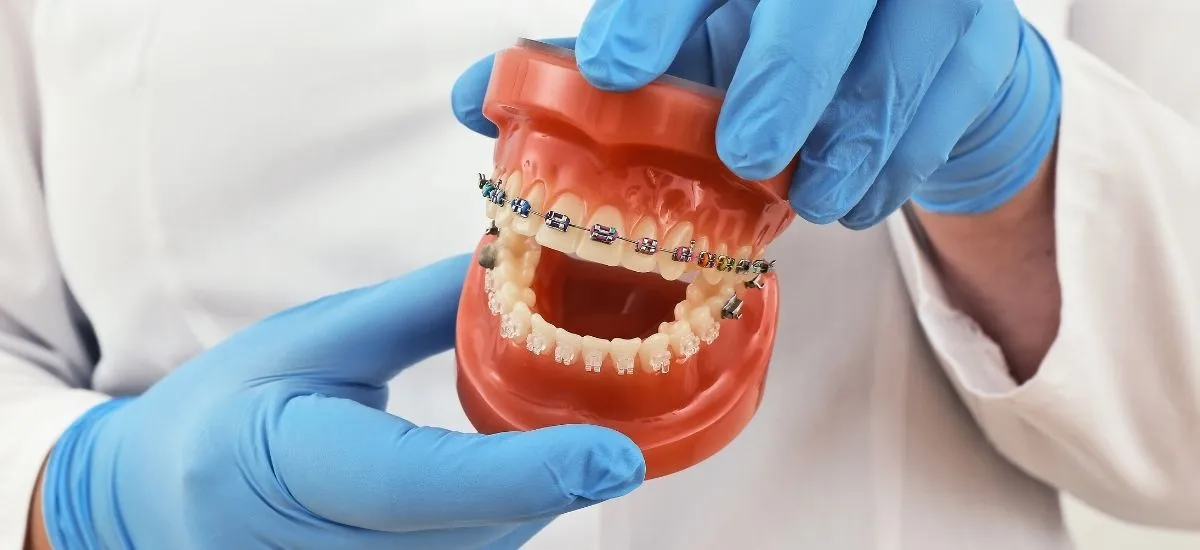
Brackets are small pieces bonded to the teeth that form part of a fixed orthodontic treatment. An archwire runs through them, applying gentle, controlled forces to move the teeth gradually.
They are not just for “straightening” the teeth you can see. Brackets can be used to correct crowding, gaps, rotated teeth and certain bite problems, always on the basis of a personalised study.
It is worth making clear that the bracket does not move the tooth on its own. It acts as an anchor point for the archwire, which is what guides each movement.
What exactly are brackets?
Brackets are part of a fixed appliance placed temporarily on the teeth to plan precise movements. Each one is positioned individually, since where it sits determines the direction in which each tooth will move.
Treatment is not simply a matter of bonding brackets and waiting. It has to be designed from a study of tooth position, the bite, the gums and the result you want to achieve.
Bracket, archwire and ligatures: the parts that make up the treatment
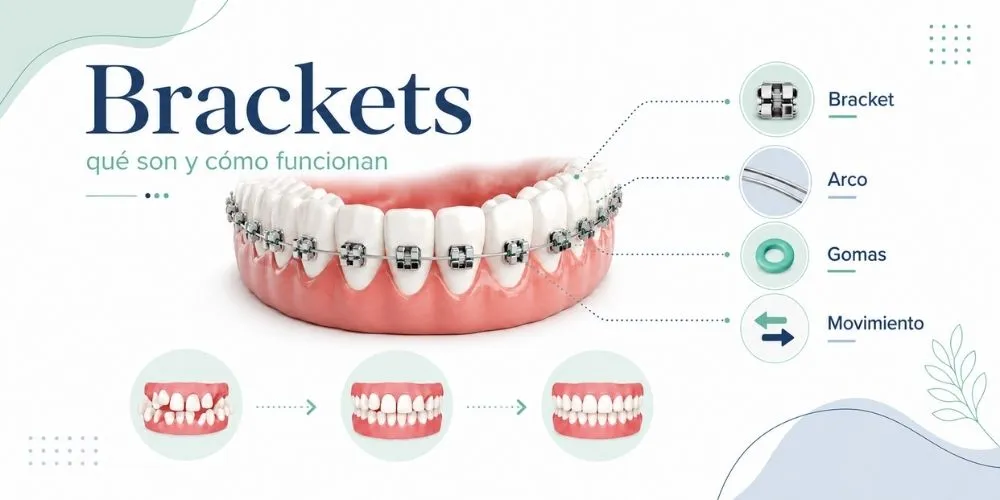
Brackets work alongside other components to move the teeth gradually. The bracket is bonded to each tooth and holds the archwire in the planned position.
The archwire connects the brackets and is what guides the movement. Many systems use ligatures or elastic bands to hold the archwire to the brackets. In certain treatments we may also prescribe intermaxillary elastics, which connect the upper and lower arches to help correct the bite.
The archwire applies a controlled, progressive force to the teeth.
How are brackets bonded to the teeth?
Brackets are fixed to the surface of each tooth with a specific dental adhesive. Before they go on, the enamel is carefully prepared and cleaned so that they bond properly.
The teeth are not drilled and no screws go into the enamel. Brackets are temporary and are removed at the end of treatment using a professional technique that takes the adhesive off in a controlled way.
How do they actually move the teeth?
The archwire exerts a gentle, constant pressure on particular teeth. That force sets off a gradual adaptation in the tissues around the root, allowing each tooth to move little by little towards the planned position.
Teeth do not shift all at once, nor all at the same pace. That is why check-ups matter: they let us see how each tooth is responding, adjust the treatment and keep guiding the movements safely.
What are brackets for?
Not every treatment with brackets has the same goal. They are adapted to the position of the teeth, the bite and the functional and aesthetic result being sought.
Besides improving the alignment of the smile, they can be used to work on problems that are not always visible at a glance.
Correcting crowded, spaced or rotated teeth
Brackets can help align crowded teeth, close or redistribute gaps and correct teeth that have come through rotated or out of position.
In cases of dental crowding, they allow the movement of each tooth to be planned to achieve a tidier smile and make daily hygiene easier. The treatment is designed taking into account the space available, the shape of the arch and the bite.
Improving bite problems
Brackets can also be used to treat certain bite problems, such as deep bite, crossbite, open bite or issues with how the upper and lower arches fit together.
In these cases the goal is not only aesthetic. A balanced bite can improve chewing function and spread the forces between the teeth more evenly. To decide on the right treatment, a complete diagnosis is needed and each case has to be assessed individually.
Moving teeth that have not come through properly
In some cases there are teeth that have not fully erupted or that have become impacted in the bone or the gum. This can happen, for example, with some canines.
Brackets can be used to create the space needed and, where indicated, help guide that tooth into its correct position. These are more complex treatments that require precise planning and, in certain cases, can be combined with other procedures.
Types of brackets: what is the difference?
There is no single type of bracket that is ideal for every patient. The choice will depend on the complexity of the case, the movements required, aesthetic preferences and the orthodontic plan drawn up.
What matters most is not just the bracket material, but that the technique chosen achieves a result that is functional, attractive and stable.
Metal brackets
Metal brackets are the most conventional option within fixed orthodontics. They are made from hard-wearing materials and allow a wide variety of tooth movements.
Although they are the most visible, they remain a very effective option for many cases. There are also smaller, more comfortable designs today than there were years ago.
Ceramic or sapphire brackets
Ceramic brackets are made from more discreet materials that blend in better with the natural colour of the teeth. They are therefore a common choice for patients who want fixed orthodontics that draws less attention.
They are still visible, particularly close up, but they are usually more discreet than metal ones. Whether they are indicated will depend on tooth position, the type of movements required and each person’s preferences.
Self-ligating brackets
Self-ligating brackets have their own system for holding the archwire, so they do not need conventional ligatures in the way other types of bracket do.
That does not mean they are better in every case, nor that they guarantee faster treatment. The technique is assessed according to the planning, the bite and the type of movement each patient needs.
Lingual and invisible orthodontics: other alternatives
Lingual orthodontics uses brackets placed on the inner surface of the teeth. They cannot be seen when you smile, although it calls for an adjustment period and specific planning.
Invisible orthodontics, by contrast, uses custom-made clear removable aligners. They can be taken out to eat and to clean your teeth, but they require consistency to be worn for the hours indicated.
The best option will depend on the complexity of the case, the look you want and your lifestyle. If you would like to know the differences between the main alternatives, you can read our guide to types of orthodontics.
What is treatment with brackets like, step by step?
Treatment with brackets starts long before they go on and does not end when they come off. Each phase has a purpose: to study the case, plan the movements, monitor progress and maintain the final result.
Initial study of the teeth, gums and bite
Before starting, we carry out a complete study of the teeth, the gums and the bite. This diagnosis lets us plan the movements needed and judge whether treatment with braces in Ibi is the most suitable option for each patient.
The study includes radiographs, intraoral photographs and a digital scan of your arches. With that information we design the sequence of movements before bonding the first bracket, rather than improvising as we go.
Fitting the brackets
Fitting brackets is a non-surgical procedure. First the teeth are cleaned and prepared, then the brackets are bonded in the planned position and finally the archwire is fitted.
The appointment is usually straightforward and needs no anaesthetic. It is normal to feel some pressure or a sense of adjustment over the first few days, but that discomfort generally eases.
Check-ups and adjustments during treatment
During treatment we hold check-ups to confirm the teeth are moving as planned. At these appointments we can adjust or change the archwires, review the bite and consider whether other elements are needed, such as intermaxillary elastics.
How often check-ups are needed depends on the case and the phase of treatment. Their purpose is to guide tooth movement in a controlled way and to catch any detail in good time.
Removing the brackets and the retention phase
At the end of treatment we remove the brackets professionally and carefully clean off the adhesive left on the teeth. Then an equally important phase begins: retention.
Retainers help keep the teeth in their new position and stop them drifting again over time. They can be fixed, removable or a combination of both, depending on each patient’s needs.
Does getting braces hurt?
Fitting brackets should not hurt. It is a non-surgical procedure in which the brackets are bonded to the teeth and the archwire is put in place.
What is common is a feeling of pressure or sensitivity over the first few days. It can also appear after some adjustments, as the teeth adapt to the new movements.
Discomfort at the start and after adjustments
When treatment begins it is normal for the teeth to feel more sensitive when chewing, or for there to be slight pressure. That sensation is usually temporary and eases as the mouth adapts.
It should not be intense, continuous pain. If the discomfort is severe, does not improve or stops you eating normally, the sensible thing is to contact the clinic so we can look at what is happening.
Rubbing and how the lips and cheeks adapt
Over the first few days the lips and cheeks may rub against the brackets until they get used to them. In some cases a small localised irritation or soreness can appear.
We can advise using orthodontic wax to cover the area that rubs temporarily and make adapting easier. If a wire is digging in, a bracket comes off or you get severe discomfort, do not try to fix it at home: contact the clinic so we can take a look.
Looking after your teeth during treatment
Dental hygiene matters especially during fixed orthodontics. Brackets, archwires and ligatures create areas where food debris and plaque can build up if cleaning is not thorough.
Keeping a good routine helps protect the enamel, the gums and the final result of the treatment.
How to brush your teeth with braces
It is important to brush carefully around each bracket, above and below the archwire, and to pay attention to the gumline. Spending a few extra minutes on hygiene can make a real difference during treatment.
Interproximal brushes can help clean the hard-to-reach areas between the archwire and the teeth. Depending on the case, we may also recommend other products or techniques to round out your routine.
Foods and habits best avoided
Some foods and habits can make a bracket come off or bend the archwire. It is best to avoid very hard or sticky foods and not to bite objects such as pens, bottle caps or your nails.
When you eat harder foods such as apples, sandwiches or nuts, it is better to cut them into small pieces rather than biting straight into them with your front teeth. These precautions help reduce mishaps and stop the treatment being delayed.
Can braces cause cavities?
Brackets do not cause cavities by themselves. The problem arises when plaque builds up around them and is not removed properly by brushing.
Insufficient hygiene can lead to cavities, white spots on the enamel or inflamed gums. That is why, during treatment, it is advisable to keep up check-ups and dental cleanings when they are indicated.
How long does treatment with braces take?
How long treatment with braces takes depends on the starting problem, the movements required, the bite and each patient’s response. There is no single timeframe that fits every case.
Once the orthodontic study is done, we can give you a closer estimate and explain what phases your treatment may involve.
Mild, moderate and complex cases
Cases of mild misalignment, small gaps or simple rotations usually call for a different approach from treatments where the bite also has to be corrected.
Where teeth are badly displaced, impacted, the bite is significantly off or there is a lack of space, treatment can be more complex. Two people who both want to “straighten their teeth” may therefore need very different timeframes and techniques.
Factors that can lengthen treatment
Brackets coming off frequently, a broken archwire or not wearing the elastics when they have been prescribed can all affect how treatment progresses.
It may also be necessary to treat cavities or gums beforehand, or to adjust the plan if a tooth responds differently from expected. Regular check-ups let us spot these details and adapt the treatment so it moves forward safely.
Brackets are a tool for improving the smile and the bite
Brackets remain an effective, precise orthodontic option for a great many cases. The key is not choosing the most popular system, but carrying out a complete diagnosis and selecting the technique that achieves a functional, attractive and stable result.
At our dental clinic in Ibi we assess your smile, your bite and your goals in order to recommend the orthodontic treatment in Ibi best suited to your case. Book your appointment through our website and find out whether braces, invisible orthodontics or another technique is the best option for you.
Frequently asked questions about braces

Santiago Espuelas
I am an orthodontist and have been practicing exclusively in orthodontics since 2005. I hold a Master’s degree in Orthodontics and Dentofacial Orthopedics from Rey Juan Carlos University in Madrid and an Expert Master’s degree in Invisible Orthodontics (2024).
I work every day with Invisalign (Platinum Elite certification), Spark (Sapphire Plus), 3M Incognito lingual braces, and conventional braces. I plan all cases using a 3Shape intraoral scanner and 3D software, so you can see what your smile will look like before we begin.
At Hernández & Espuelas (Ibi), I handle all aspects of orthodontics for children, teenagers, and adults. In this blog, I write about the questions you ask me most often during your appointments: what type of orthodontic treatment is right for you, how long treatment takes, and how to maintain the results.

