
Índice de contenidos
When you compare braces and Invisalign, it is easy to focus on the obvious: braces are fixed and more visible; Invisalign is clear and removable.
But the important difference is not what they can correct: today both treat the same cases, complex ones included. What changes is the aesthetics, the comfort, the hygiene and whether you can stick properly to a removable treatment.
Braces or Invisalign: the quick answer
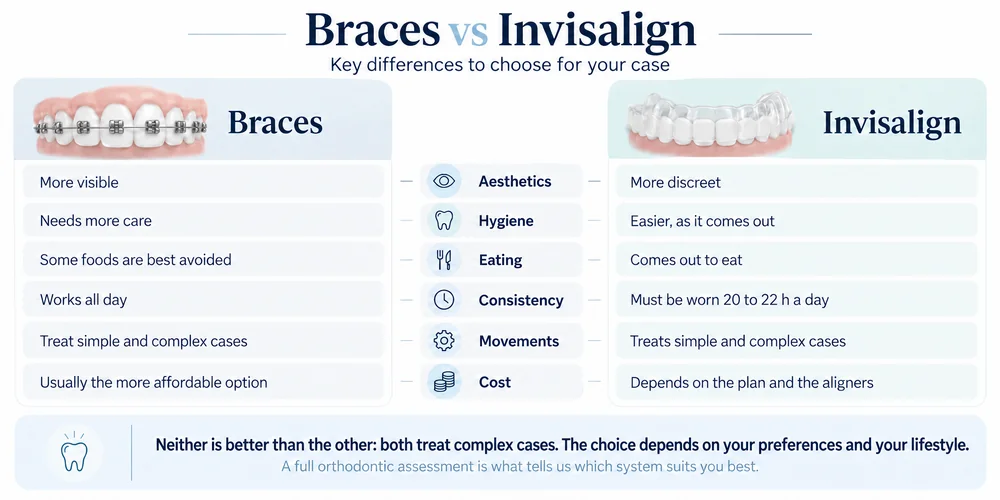
Both systems achieve excellent results, complex cases included. Neither is better than the other: you can choose according to your preferences, your lifestyle and whether you can wear the aligners for the prescribed hours.
Invisalign is more discreet and makes hygiene easier, but it depends heavily on consistency. Braces stay active all day and do not depend on you remembering to put them in.
| If your priority is… | Might suit you better | What to bear in mind |
|---|---|---|
| Maximum discretion | Invisalign | You need to wear it 20 to 22 h a day |
| Not having to remember | Braces | They are visible and fixed |
| Eating without restrictions | Invisalign | You have to take it out and put it back in |
| Treating a complex case | Either one | Both handle it equally well |
| Easy hygiene | Invisalign | Teeth and aligners both need cleaning |
| Lower cost | Often metal braces | Depends on the case and the treatment plan |
This comparison is a useful guide. Before you decide, we study the bite, the position of the teeth and the movements we need to carry out, so that we can plan the treatment properly with whichever system you choose.
The main difference: one is fixed and the other depends on you
Braces stay bonded to the teeth throughout treatment. Aligners can be taken out, which is very convenient, but it also means that they only work if you wear them for the prescribed time.
This difference has a big effect on daily life. With braces, the system is always working. With Invisalign, on the other hand, part of the success depends on the patient being consistent and wearing the aligners for the recommended hours.
How braces work
Braces are bonded to the teeth and connected by an archwire that transmits controlled forces to move them gradually.
During treatment we change archwires, ligatures and other elements depending on the movement we need to achieve. In some cases we may also use elastics, springs or mini-screws to gain more control over particular teeth or over the bite.
Because the appliance is fixed, it stays active all day and does not depend on the patient remembering to put it back in after eating.
How Invisalign works
Invisalign uses a sequence of clear aligners designed digitally to move the teeth gradually.
Each aligner represents one stage of treatment and must be worn for the prescribed time before moving on to the next. And the clear aligner is not always enough on its own: depending on the case, we may need attachments, elastics or other auxiliaries to achieve certain movements.
Digital planning lets us anticipate how we want to move the teeth, but the actual result depends on how each tooth responds and on the patient following the instructions properly.
Why cooperation matters more with Invisalign
With Invisalign, consistency is part of the treatment.
The usual recommendation is to wear the aligners for 20 to 22 hours a day, taking them out only to eat, drink anything other than water and clean your teeth.
That does not mean you have to live with one eye on the clock, but it does mean understanding that if the aligners spend too many hours out of your mouth, the teeth may not follow the planned movement at the planned pace.
That is why Invisalign can be a very comfortable option for many people, but not necessarily for someone who knows they will struggle to wear the aligners consistently. In that case, a fixed system may be easier to keep on track.
What movements braces and Invisalign can achieve
Today aligners treat the same cases as braces, complex ones included. What changes is the tool we use to achieve each movement: the archwire and bracket in one case, the aligner with its attachments and auxiliaries in the other.
The important question is not just how crooked the teeth look, but which movements we need to make to position them correctly and improve the bite.
Crowding and alignment
Both braces and Invisalign work very well for crowding and misalignment, from mild cases to the most severe.
When space is lacking, we create it properly with either system.
So the choice can depend mainly on factors such as looks, hygiene, comfort and the patient’s preferences.
Rotations
Rotations are corrected with both systems. With aligners, when the shape of the tooth makes it hard for the aligner to grip, we place attachments that give it the anchor point it needs.
With good planning, Invisalign also corrects the most marked rotations, just as braces do.
What matters is planning the degree of rotation, the shape of the tooth and the other movements in the treatment properly.
Root movement and torque
Moving the visible crown of the tooth is not the same as also controlling the position of its root.
Torque refers precisely to controlling that inclination and the relationship between crown and root. With braces, that control comes through the archwire and the position of the bracket on the tooth.
With aligners we achieve it just the same: we plan the root movements in the software and use attachments or auxiliaries when they are needed.
Closing gaps and cases with extractions
When teeth need to be extracted to gain space, closing those gaps properly involves more than just moving the crowns.
We have to control the inclination of the teeth, the roots and the bite as the gap closes.
Cases with extractions are treated with braces and also with aligners. With Invisalign or Spark we plan the closure from the start and rely on attachments, elastics or mini-screws to control every tooth right to the end.
Complex bites
Problems such as open bites, deep bites, Class II or Class III discrepancies or major movements are treated with braces and also with aligners.
To do this, aligners are combined with attachments, elastics, mini-screws or other auxiliaries, just as braces rely on their own.
So saying that “Invisalign does not work for complex cases” is a myth: today it treats complex cases just as well as braces.
Does Invisalign work for complex cases?
Yes. Invisalign and Spark treat complex cases with results equivalent to those of braces.
Complexity does not depend only on how misaligned the teeth look in a photo. What also matters is how the arches fit together, the position of the roots, the bone available, the space we need to gain and the movements needed to correct the bite.
For example, one patient may have crowding that looks striking but is relatively simple to resolve, while another with fairly straight teeth may have a bite problem that needs much more control.
In cases with large rotations, gap closure after extractions, significant root movements or certain discrepancies between the arches, we combine the aligners with attachments, elastics or mini-screws, just as we would use auxiliaries with braces.
So to plan a complex case properly with Invisalign, looking at the teeth from the front is not enough. We need to study the bite, the roots, the bone and the complete treatment plan.
Which is more comfortable: braces or Invisalign?
Generally speaking, Invisalign tends to be more comfortable day to day because it has no wires or bonded brackets that can rub against the inside of your mouth. But saying it is completely painless would not be accurate either.
Both systems move teeth, so both can cause temporary pressure or discomfort.
Discomfort from tooth movement
When we start orthodontic treatment or make an adjustment, the teeth receive forces that trigger a response in the tissues around them.
That is why it is normal to feel pressure or sensitivity when chewing for a few days, with both braces and aligners.
The intensity varies from patient to patient and with the stage of treatment.
Rubbing and sores
With braces, small sores can appear on the lips or cheeks, especially during the first few weeks or after certain adjustments.
The tissue usually adapts gradually, and we can use orthodontic wax if any area becomes uncomfortable.
With Invisalign this kind of rubbing is less common because the surface is smoother, although a particular edge of the aligner may also need a small adjustment if it irritates the gum or the inside of the mouth.
Pressure from a new aligner
Each time you change aligners, it is normal to feel the new one pressing harder during the first few hours or days.
That pressure shows that the new aligner is trying to move the teeth towards the next planned position.
It usually eases as the teeth adapt, but the feeling can come back with each change of aligner.
Speech and adjustment
Invisalign is discreet, but that does not mean there is no adjustment period.
During the first few days some people notice a slight change when pronouncing certain sounds, mainly because the tongue has to get used to the extra thickness of the aligner.
There is also an adjustment period with braces, although it is usually more related to the feeling of bulk and the initial rubbing.
In both cases, patients usually get used to it gradually. The difference is that Invisalign tends to offer a more comfortable daily experience for many people, but comfort should not be the only criterion for choosing a treatment.
Hygiene: here Invisalign does have a clear practical advantage
One of the most obvious differences between the two systems shows up in daily hygiene. Aligners can be taken out to brush your teeth and floss, whereas with braces you have to clean around each tooth, the archwire and the spaces between the hardware.
This makes hygiene with Invisalign easier for many people, but it does not automatically make it better. If the patient puts the aligners back in over teeth with food debris or does not clean the aligners properly, problems can also arise.
Hygiene with braces
With braces you need to pay more attention to brushing because plaque and food debris can build up around the brackets and the archwire.
As well as your usual toothbrush, interdental brushes or other hygiene aids can help you reach the trickiest areas.
It is not an impossible routine, but it does take a bit more technique and consistency throughout treatment.
Hygiene with Invisalign
With Invisalign you can take the aligners out and brush your teeth almost exactly as you did before starting orthodontics, as well as flossing normally.
The other part of the routine is keeping the aligners themselves clean. There is little point brushing perfectly and then putting back an aligner with residue on it.
So its practical advantage lies in making it easier to reach the teeth, but hygiene still depends on the patient’s habits.
Eating with braces vs eating with Invisalign
Food is another of the differences you notice most from day to day.
With both systems you can keep a normal diet, but the way you eat changes because braces stay fixed while aligners come out before every meal.
With braces
During treatment with braces it is wise to take a little more care with foods that are very hard, sticky or difficult to bite into, because they can loosen a bracket, bend an archwire or get trapped in the appliance.
This does not mean living on a restrictive diet, but it does mean adapting some habits. For example, it may be better to cut certain foods into pieces rather than biting into them directly.
With Invisalign
The aligners come out when you eat, so there are not the same dietary restrictions as with braces.
You can eat almost normally and put them back in after cleaning your teeth and the aligners.
The downside is that every meal means taking them out and putting them back in afterwards. And that time counts towards the daily hours they need to be worn.
Which treatment is faster?
Neither is always faster. How long orthodontic treatment takes depends much more on the complexity of the case and the movements needed than on simply choosing braces or Invisalign.
A relatively simple treatment can be resolved in a similar way with either system, while other cases need more time because of gap closures, large root movements, bite correction or the need for extractions.
With Invisalign, cooperation also plays a particularly important role. If the aligners are not worn for the prescribed hours, the teeth may not follow the plan properly and treatment may take longer.
Refinements may also be needed. With braces, for their part, there can be breakages, loose brackets or extra phases with elastics and other auxiliaries.
That is why we avoid giving a generic figure along the lines of “Invisalign takes X months and braces take Y”. The real timeframe can only be estimated after studying the case.
Invisalign and refinements: something worth understanding before you choose
One of the ideas that causes most confusion with Invisalign is thinking that the initial number of aligners necessarily equals the full length of treatment.
Digital planning shows us a sequence of movements, but teeth do not always respond exactly as planned.
At certain points we may need to take a new scan and design an additional series of aligners. This is what we usually call a refinement.
It does not necessarily mean the treatment has failed. It is part of the option to adjust movements that are not yet complete or improve small details of position and bite.
So when we talk about duration with aligners, bear in mind that the first set of aligners may not necessarily be the last.
It also explains why check-ups are still important even when treatment is planned digitally: we need to check that the actual movement matches the planned movement.
Braces can also need adjustments and auxiliary appliances
Braces being fixed does not mean simply fitting them and waiting for the teeth to move on their own.
During treatment we keep changing archwires, forces and auxiliary elements depending on the stage we are at.
In some cases we will need elastics to work on the relationship between the arches, springs to open or close spaces, mini-screws to get extra anchor points or even to reposition a bracket if we want to change the direction of a movement.
So both braces and Invisalign need follow-up.
The difference is that the way movements are controlled and adjusted is different, but both treatments need planning and regular check-ups.
Which is more aesthetic?
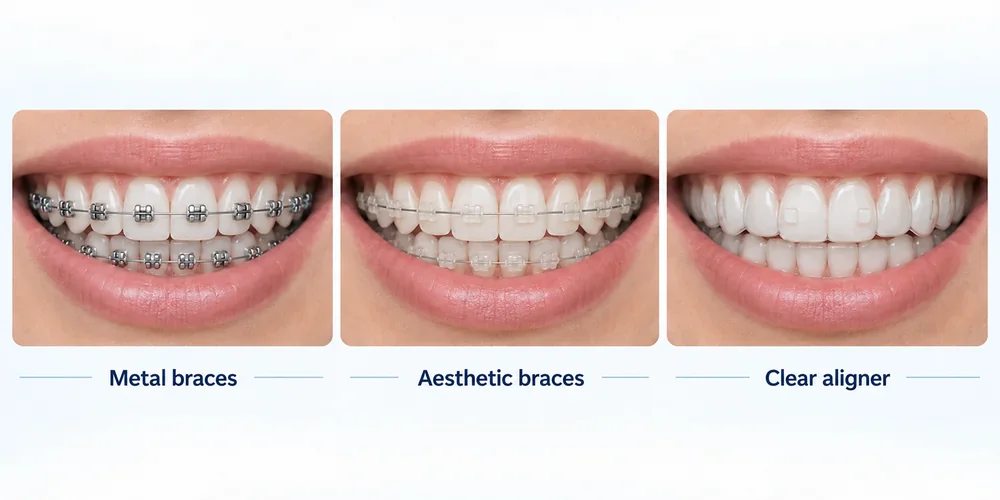
If your main priority is for your orthodontics to be as unnoticeable as possible, Invisalign usually has a clear advantage.
Aligners are clear and fit the shape of the teeth, so from a certain distance they can go largely unnoticed.
Invisalign
Although we talk about invisible orthodontics, it is important to point out that it is not literally invisible.
In many treatments we need to place small tooth-coloured attachments that help the aligner carry out certain movements. Elastics may also be needed at some stages.
Even so, it is still much more discreet visually than metal braces.
Aesthetic braces
If you prefer a fixed system but are concerned about appearance, there are also ceramic braces or braces made of other aesthetic materials that blend in better with the colour of the teeth.
They are not quite as discreet as clear aligners, but they can offer a middle ground between aesthetics and fixed orthodontics.
You can explore the different options on our page about braces in Ibi and in our guide to types of orthodontics.
Invisalign vs braces cost: what it really depends on
There is no single price for Invisalign or for braces, because the cost depends on the whole treatment, not just on the appliance we use.
Factors include the complexity of the case, the estimated duration, the system chosen, the number of aligners, any refinements that may be needed, the use of auxiliaries and, with braces, the type of material.
Generally speaking, metal braces tend to be among the more affordable options, while invisible orthodontics systems may cost differently because of the planning and custom manufacturing of the aligners.
But the only way to compare both options properly is to do so after studying the bite and knowing what treatment each case needs.
At Hernández & Espuelas we carry out the initial assessment and, from there, explain the alternatives and the quote to you on a personalised basis.
So when might braces suit you better?
Braces can be a particularly good option if you prefer a fixed treatment that does not depend on remembering how many hours you have worn the appliance.
They can also make sense when we know that wearing aligners for 20 to 22 hours would be difficult with your daily routine.
What does not decide the choice is how difficult the case is: a complex case is treated just as well with Invisalign as with braces. The choice depends on your preferences and your lifestyle.
And when might Invisalign suit you better?
Invisalign can be particularly appealing if you place a high value on discretion, easy hygiene and being able to take the appliance out to eat.
It can also be a very good option if you can be consistent with daily wear time, whether your case is simple or complex.
For many patients, being able to wear orthodontics that interferes less visually with their work or social life is also an important factor.
The key is the same once again: Invisalign can treat any bite, but it only works if you wear it for the prescribed hours.
What we assess before recommending one or the other
At the consultation we do not start by asking whether you prefer Invisalign or braces. First we study the position of the teeth, the roots, the bite, the bone and the movements we need to carry out.
We carry out a full examination and use records such as photographs, X-rays and intraoral scanning to understand the starting situation precisely.
With that information we can plan how we want to move each tooth and explain how we would do it with each system.
We also take very practical matters into account: your age, your habits, how much you value aesthetics and whether you will be able to follow the instructions of a removable treatment properly.
At our dental clinic in Ibi we work with both braces and clear aligner systems such as Invisalign and Spark, which lets us plan treatment around the diagnosis rather than limiting it to a single technique.
Braces or Invisalign: both work, complex cases included
Braces and Invisalign achieve excellent results in every kind of case, so you can choose the one that suits you best.
The first thing is to know what movements your mouth needs. Then we can assess which system offers the best balance between aesthetics, comfort, hygiene and how you want to live with your treatment.
Both systems can treat your case, whether it is simple or complex, so your preferences and your lifestyle will carry a lot of weight in the decision.
That is why, before deciding, the important thing is to carry out a full assessment and understand what we want to correct and how we can do it as predictably as possible.
If you are thinking about starting orthodontic treatment and still do not know which option to choose, you can book a first visit through our website.
Frequently asked questions about braces and Invisalign

Santiago Espuelas
I am an orthodontist and have been practicing exclusively in orthodontics since 2005. I hold a Master’s degree in Orthodontics and Dentofacial Orthopedics from Rey Juan Carlos University in Madrid and an Expert Master’s degree in Invisible Orthodontics (2024).
I work every day with Invisalign (Platinum Elite certification), Spark (Sapphire Plus), 3M Incognito lingual braces, and conventional braces. I plan all cases using a 3Shape intraoral scanner and 3D software, so you can see what your smile will look like before we begin.
At Hernández & Espuelas (Ibi), I handle all aspects of orthodontics for children, teenagers, and adults. In this blog, I write about the questions you ask me most often during your appointments: what type of orthodontic treatment is right for you, how long treatment takes, and how to maintain the results.

